
'We should carefully handle issues concerning each other's core interests. We should properly manage and control problems that cannot be solved for the time being'

'It is nobody's contention that uncomfortable questions regarding national security should not be raised. But that is a topic for another day and another time when the immediate threat has faded,' argues Vivek Gumaste.
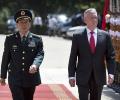
'A hotline between the Chinese and Indian military establishments is essential if the possibility of conflict is to be minimised.' 'When relations are uneasy, even minor incidents can spiral out of control,' warns former senior RA&W officer Jayadeva Ranade.

'Have you met anyone who said "I will not boycott Chinese products"?'

Chinese President Xi Jinping, who made a rare visit this week to the restive Xinjiang region which borders Ladakh, met the troops and officers stationed there and praised their "outstanding contributions" to the border defence and stabilisation of the volatile province.

In a few years from now, India will be looking at an entirely different type of military adversary across the borders, in our waters, in the air, in space and in our communication networks, says Nitin Pai.

It is only the Indian approach of holding on to multiple realities and contradictory ideas simultaneously that is likely to deliver peace and progress. Binary logic is out of sync with reality, notes R Jagannathan.
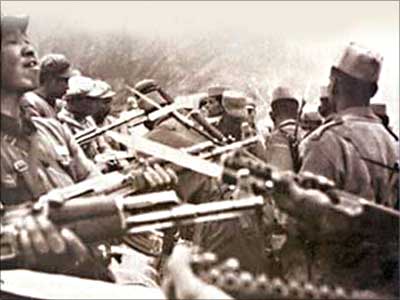
From March 1959 to March 1962, the PLA fought 12 major battles in central Tibet which was seen as an opportunity to train China's soldiers, notes Ajai Shukla.

'But unlike Bond who killed an individual, Israel is killing a nation.'
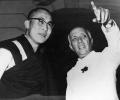
One priority for Delhi (for the new foreign secretary in particular) is to have an in-depth discussion with Dharamsala as soon as possible, suggests Claude Arpi.

'Extending the range of the DF-21D could challenge Indian aircraft carriers if the missiles are launched from southwest China. Also, if Pakistan acquires these systems, these missiles could directly challenge India's aircraft carriers.'
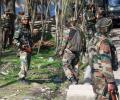
50 terrorists had been killed this year while 12 security forces personnel lost their lives.

'This is the only place on earth where Elephas maximus climbs to these heights.'

We can make a beginning by openly acknowledging the Russian help in 1971 victory when President Putin visits India on 6 December 2021. Showing gratitude to a friend is part of our DNA, notes Colonel Anil A Athale (retd).

'The fatal mistake for the USSR was the invasion of Afghanistan.' 'Quite possibly the fatal mistake for the Chinese empire is the assault on Ladakh,' observes Rajeev Srinivasan.

Adityanath said there was no discrimination in the schemes being run by the central government and they were meant for the welfare of all including Dalits and backwards.

A war hero looks back at the men and the moments that forged India's greatest military victory.

Sitharaman had a brief conversation with Chinese soldiers during her maiden visit to the Nathu La border post in Sikkim.

What the ceasefire does is to show the supporters of violence in the Kashmir valley an alternative to militancy, argues Colonel Anil A Athale (retd).
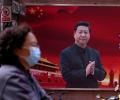
China has not limited the 'battle' to the diplomatic field alone; the People's Liberation Army has become aggressive on the ground too. The recent 'fights' in Northern Sikkim and Ladakh are part of the pattern, asserts Claude Arpi.

On December 10, Kissinger began to encourage the Chinese to take action against India: 'If the People's Republic were to consider the situation on the Indian subcontinent a threat to security, and if it took measures to protect its security, the US would oppose efforts of others to interfere with the People's Republic.' On the 50th anniversary of India's greatest military victory, Claude Arpi recalls how the US suggested that China intervene militarily on Pakistan's side.

We're behaving like frogs in warm water. We swim around untroubled, cooled by our faith in Indian liberal democracy. We are blind to the bubbles popping around us, the bubbles warning of fundamental changes, says Mihir S Sharma.

'I can't help it if people don't love the minorities, the Dalits and Adivasis; they are as much of this country as any other Indian.' 'If I love them, it does not mean I do not love my country.' 'It is ironic and funny that they have laid such severe anti-national charges against me.'

Fourteen years after the Sri Lankan government announced his death, a veteran Tamil nationalist leader claimed in Thanjavur, Tamil Nadu, on Monday that Velupillai Prabhakaran, the leader of Eelam Tamils in Sri Lanka, is doing well and said a conducive atmosphere prevails for him to appear now.

'It is only when Beijing sees a country with an infirm political will such as India that it acts up as the PLA has done in eastern Ladakh.'

The stand by China spelt out by its foreign ministry insisting that it takes the 1959 line on perception of the LAC amid a nearly five-month-long border standoff in eastern Ladakh triggered a strong reaction from India.

'The Chinese forces in the narrow Chumbi Valley are currently in the line of sight and fire of Indian forces poised on the ridges along the Sikkim-Tibet border.' 'Aware of this vulnerability, the Chinese have been eyeing the Doklam plateau,' explains national security expert Nitin A Gokhale.

Prime Minister Narendra Modi's visit to Arunachal Pradesh on Friday, February 20, irritated the Chinese government so much that it summoned the Indian ambassador to register its protest against Modi visiting a territory China claims as Southern Tibet.
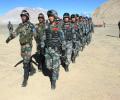
Esper also highlighted the 'increased' military cooperation with India and called it as 'one of the most important defence relationships of the 21th century'.
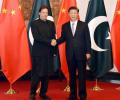
'The scheduling of Imran Khan's visit to Beijing and its focus on the J&K situation underscores that Beijing shares the Pakistani concern that tensions with India are only going to escalate further in the period ahead,' says Ambassador M K Bhadrakumar.

By jettisoning the vision of multilateral world in favour of a Han Empire, China has posed a major long term challenge to India. India must stand firm against Chinese expansionism but also keep a door open for future detente by making a clear distinction between Chinese people and the current Chinese leadership, observe Lieutenant General Ashok Joshi (Retd) and Colonel Anil Athale (Retd).

'General J S Aurora, the commander of the Indian forces in the East, asked General Sagat Singh to withdraw his troops who were on the move to Dacca -- but he refused.' 'He said, "Jaggi, over my dead body".' 'Therefore, I say the creator of Bangladesh was General Sagat Singh.'
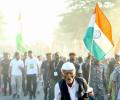
There they were, showing the world that there are still people motivated not by religious structures, not by past glories, not by hatreds deliberately stoked. These were ordinary folks doing something extraordinary purely because they think that effort might shake a nation out of a spiralling miasma of division, mistrust, cynicism, sophistry and violence.

India's voting pattern in the United Nations with regard to the Israel-Palestine conflict is lately marked by a calibrated distancing from Israel, observes Ambassador M K Bhadrakumar.
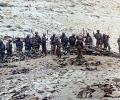
In fact, given the current tensions and massed troops on both sides, there is a danger that the LAC will become more like the Line of Control with Pakistan, a heavily fortified and strongly defended border where weapon fire exchanges regularly occur. Indeed, Stratfor Worldview research has listed a sharp increase in new Chinese facilities along the LAC in 2019-20.

Did Vinod Sehgal die in Tsangdgar or was he taken PoW to Tibet or China? Why has the IAF kept so quiet for all these years, asks Claude Arpi.

'We don't know what the reasons were that we gave back the Haji Pir Pass which was strategically very important. Today the entire infiltration into Kashmir takes place from that area. If we had retained that post that we had captured, things could have been different.' 'A lesson we need to learn is if you start losing the gains of war at the negotiating table, they become a disincentive for future wars,' says Lieutenant General D B Shekatkar (retd), reviewing the lessons from the 1965 War.
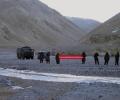
'Demchock and Chumar are important crucibles for both China and India to know about the other. While India 'learns,' she also need to 'teach,' suggests Lieutenant General Anil Chait, one of the Indian Army's most cerebral thinkers, who recently retired as chief of the Integrated Defence Staff.

On the title page of the Top Secret Report, Henderson-Brooks quotes the Chinese tactician Sun Tzu: 'Know yourself, know your enemy: A hundred battles, a hundred victories', says Claude Arpi, highlighting where the Indian Army and government failed to counter the Chinese attack in 1962.

'Parsis are brought up with a great sense of the importance of truth and speaking your mind.'
 © 2026 Rediff.com - Advertise with us - Disclaimer - Privacy Policy - Sitemap - Feedback - About us - Terms of use - Grievances